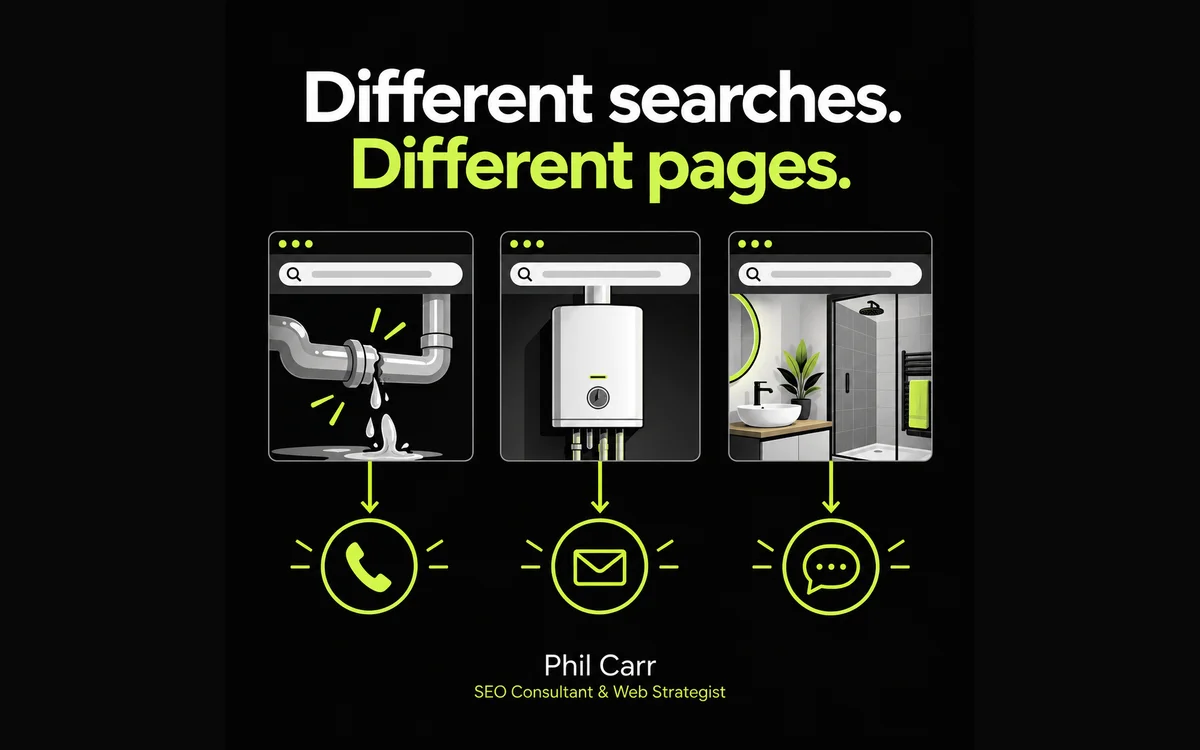
Heating work divides cleanly by urgency and by value, and the searches follow. "No hot water" at seven in the morning and "new boiler quote" on a Sunday evening are different people with different expectations, and a website that treats them the same loses one of them.
Four jobs, four pages
- Breakdowns and repairs — urgent, mobile, decided in minutes. The phone number, the coverage area and whether you can come today are the whole page.
- Boiler installation and replacement — the highest-value work and the most researched. People want to understand combi versus system, what the install involves, how long it takes, what warranty comes with it, and how a quote is produced without a sales visit.
- Servicing and safety checks — annual, predictable, and the work that turns a one-off customer into a recurring one. Landlords search for this differently to homeowners, so say plainly whether you issue landlord gas safety records.
- Heat pumps and low-carbon heating — growing, grant-linked and full of questions. If you are certified to install them, say which certification; if you are not yet, it is better to say nothing than to imply it.
Credentials do the convincing
Gas work is one of the few trades where the customer knows to check a registration before they book. Your Gas Safe registration number belongs on the site where it can be seen, along with any manufacturer accreditations that let you offer extended warranties, and any low-carbon certification you hold. These are verifiable facts about your business, and they are exactly the trust signals both customers and search engines weigh. Never list an accreditation you do not currently hold.
Emergency searches and how to win them
For breakdown work, the map pack is the battleground. That means a Google Business Profile with accurate hours — including whether you genuinely answer out of hours — the right primary category, and recent reviews. On the website, the emergency page should load fast, put the number above the fold, state the areas you cover, and say what happens when you arrive. Long explanations belong on the installation pages, not here.
Installation enquiries reward the opposite: detail, worked examples, clear next steps, and an honest account of what affects the price. The plumbing SEO page covers the overlapping bathroom and general plumbing searches, and the trades SEO page covers how local trade search works more generally.
Frequently asked questions
No. Breakdown searches want a phone number and a coverage area in the first screen; installation searches want detail, options and reassurance. Sharing a page means compromising both.
Somewhere visible on the site — the footer plus the relevant service pages is usual — and on the Google Business Profile. It is a verifiable credential, and for gas work it is often the first thing a careful customer checks.
Only if you are certified to install them. A page that implies capability you do not have wastes the enquiry and damages trust. If you are certified, it is worth a page of its own, because the questions are quite different from boiler work.
Write for that audience specifically: certificates issued, turnaround times, how access is arranged, whether you handle multiple properties. Landlords search in their own words, and almost no heating websites answer them directly.
Review volume, recency and content all feed local ranking, and they affect whether someone calls you once you appear. Asking customers to mention the job they had done makes those reviews work harder than a bare star rating.