
Published: Last updated:
TL;DR
For the full service-page framework, see SEO for plumbers.
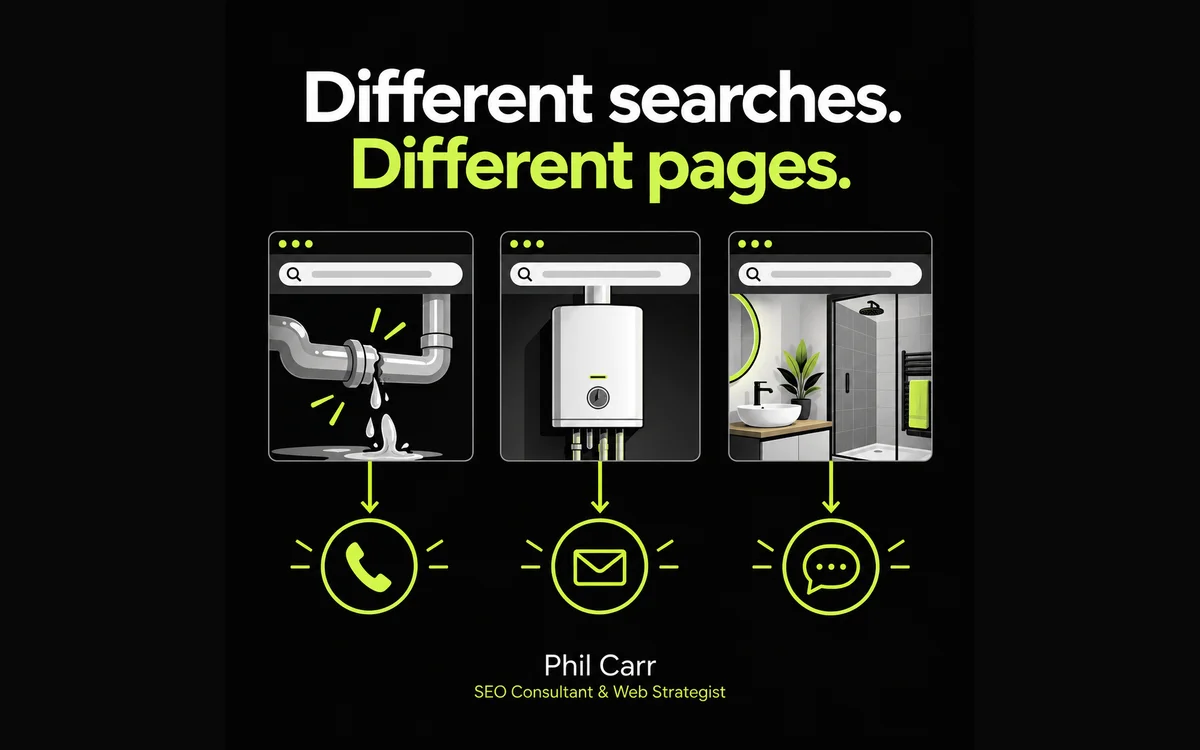
Why plumbing searches should not all land on one page
Most plumbing websites try to serve every visitor from a single "Plumbing Services" page. That creates a mismatch. Someone with water coming through the ceiling wants a phone number, availability, and proof that you cover their postcode. Someone comparing boiler installers wants Gas Safe details, manufacturer experience, finance options, review proof, and a sense of price.
Google sees the mismatch too. A broad page often struggles to rank because it is not the best answer for any one search. Splitting the site by intent makes each page more useful and easier to understand.
Emergency plumbing pages
Emergency pages should be built around speed and trust. The page needs to answer the visitor's immediate questions before they scroll:
- Do you cover my area?
- Are you available now or today?
- What problems do you attend?
- How do I contact you quickly?
- Are you qualified and reviewed?
The main call to action should be click-to-call, especially on mobile. Forms can still exist, but they are secondary. Useful content includes what to do before the plumber arrives, what counts as an emergency, and when the customer should contact their water supplier or insurer.
Boiler installation and servicing pages
Boiler searches are slower and more considered. The visitor may compare brands, warranties, finance, and ongoing servicing. A strong boiler page should include:
- Gas Safe registration and relevant manufacturer accreditation
- The types of boiler work offered
- Typical installation process and timescales
- Pricing guidance or factors that affect cost
- Warranty and aftercare information
- Review snippets and recent examples
These details help customers feel safer about enquiring and give search engines richer context than a thin services list.
Bathroom and planned project pages
Bathroom fitting, en-suite upgrades, and renovation work should be treated differently again. These searches are visual, budget-led, and often involve multiple trades. The page needs proof of finished work, project stages, realistic timescales, and clarity on whether you manage tiling, electrics, plastering, and disposal.
For plumbing firms that want more planned work, these pages often convert better than emergency pages because the visitor has more time to compare and the average job value is higher.
Landlord and commercial plumbing searches
Landlord gas safety certificates, servicing contracts, and commercial maintenance deserve their own pages if they are a priority. These buyers care about compliance, record keeping, punctuality, and repeatability. The copy should be more operational and less domestic.
Local SEO signals that support the pages
Each page should be backed by a complete Google Business Profile, consistent citations, service-area information, recent photos, and steady review acquisition. The website and local profile should describe the same services in the same towns, otherwise Google receives mixed signals.
Useful internal links also matter. Emergency plumbing can link to boiler servicing where relevant, while boiler pages can link to landlord gas safety or planned maintenance. Those links help visitors move naturally and help Google understand the service relationships.
What to measure
Do not measure plumbing SEO as one blended traffic number. Separate emergency calls, boiler quote requests, bathroom enquiries, landlord leads, and commercial maintenance enquiries. That shows which part of the website is creating useful work rather than just visits.
Want a clearer plumbing SEO structure?
The SEO for plumbers page explains how I structure plumbing service pages, local SEO, and conversion paths for firms that want more of the right enquiries.